You come home exhausted, your partner says the wrong thing, and suddenly a small comment turns into a full-blown argument. Does that sound familiar? Chronic stress doesn’t just wear you down. It chips away at your relationship in ways you may not even notice. The good news is that there is a surprisingly simple, science-backed way to reset the tension. Heat therapy.
Stress Does More Damage Than You Think
Most couples are unaware that stress plays a silent role in their relationship. It’s not always about money fights or major disagreements. It’s the low-grade, constant hum of work pressure, parenting chaos, and daily overwhelm that slowly erodes the connection between two people who genuinely care about each other.
Stress is a common part of daily life. Research from the National Institutes of Health shows that everyday stress regularly spills over into marital conflict, meaning the tension you pick up at work follows you right through the front door. When one partner is stressed, the other feels it. When both partners are stressed, the relationship absorbs the pressure like a sponge, often reaching a breaking point.
Here’s what that looks like in real life. You stop having real conversations. Physical intimacy drops. Small annoyances feel like personal attacks. When you’re in survival mode, your marriage becomes the first thing you neglect, thinking it will just “be fine.”
The Cortisol Problem No One Talks About
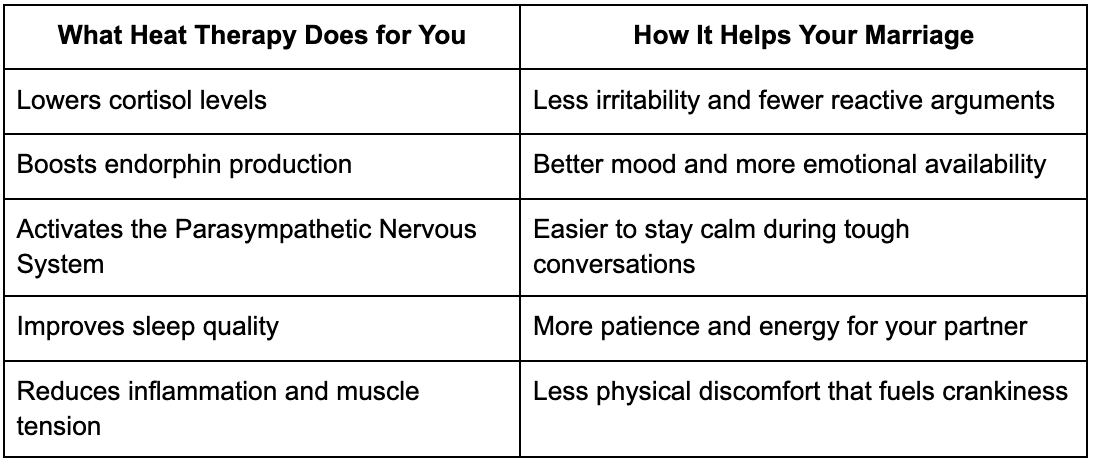
Cortisol, your body’s main stress hormone, is at the heart of this. When you are chronically stressed, your cortisol levels stay elevated for long stretches. That doesn’t just make you feel anxious and irritable. It actually changes how your brain processes social interactions, making you more reactive, less patient, and quicker to interpret your partner’s words as criticism.
This aspect is where most advice falls short. “Just communicate better” doesn’t work when your nervous system is stuck in fight-or-flight mode. You need to address the stress itself at a physiological level before relationship strategies can truly help. This is why solutions like Polar Recovery and other heat therapy approaches are worth paying attention to. They target the root of the problem, not just the symptoms.
Common signs that cortisol is affecting your relationship:
- You feel emotionally drained before you even walk through the door
- Physical affection and intimacy have quietly disappeared
- You overreact to small comments or minor inconveniences
- You’d rather scroll your phone than have a real conversation
- Sleep is poor, which makes everything feel harder the next day
Elevated cortisol also messes with your sleep, tanks your energy, and reduces the production of feel-good chemicals like endorphins and serotonin. So, you are not just stressed. You are emotionally depleted, which leaves little to offer your relationship.
How Heat Therapy Resets Your Stress Response
Heat therapy, whether through saunas, infrared blankets, or hot tubs, works by applying controlled, mild stress to the body, known as hormesis. Your core temperature rises, your heart rate increases slightly, and your body responds by activating the parasympathetic nervous system, the “rest and digest” mode that directly counteracts the stress response.
A randomized clinical trial published in JAMA Psychiatry found that even a single session of whole-body hyperthermia significantly reduced depression symptoms for up to six weeks afterward. That’s not a warm bath making you feel comfortable for an hour. That’s a measurable, lasting shift in mood and stress regulation from one session.
Regular heat exposure also stimulates endorphin release and promotes better sleep, two factors that directly impact how you show up in your relationship. When you sleep better and your mood is more stable, you’re less likely to snap at your partner over dishes in the sink.
Why This Matters for Your Marriage
Think of heat therapy as relationship maintenance that doesn’t feel like work. In a time when stress and emotional disconnection are affecting the majority of Americans, anything that helps both partners decompress is worth incorporating into your routine. When you are both less stressed, conversations flow more easily. When you’re both less stressed, conversations get easier. Patience comes more naturally. You actually want to spend time together instead of retreating to opposite ends of the couch.
There is also a hormonal benefit to consider. Relaxation practices, especially those involving warmth and physical comfort, are linked to increased activity in the body’s oxytocin system. Oxytocin is often called the “bonding hormone” because it promotes feelings of closeness, trust, and connection. While the research on heat therapy and oxytocin specifically is still emerging, the broader science is clear: when your stress hormones go down, your capacity for intimacy and emotional connection goes up.
And if you make it a shared activity? Even better. Couples who build relaxation rituals together report feeling more aligned and emotionally supported. You don’t need a couples retreat or an expensive therapist to start. Even something as simple as using laughter as a form of self-care or 20 to 30 minutes of intentional decompression a few times a week can make a real difference. Small, consistent moments of relaxation can strengthen your bond over time.
Building a Heat Therapy Routine Together
Getting started doesn’t have to be complicated. Here’s a simple framework that works for most couples.
- Start small. Two to three sessions per week, about 20 minutes each.
- Pick your method. Traditional saunas work well at 150 to 175 degrees Fahrenheit. Infrared options run at lower temperatures and are easier for beginners.
- Make it phone-free. The whole point is to disconnect from the noise and actually be present together.
- Add a simple cool-down ritual. A glass of water on the porch, a short walk, or just sitting together for a few minutes afterward.
Stay consistent. One session won’t fix months of accumulated stress, but a regular routine can genuinely shift the emotional baseline of your home.
- These micro-rituals compound over time and become anchors for your relationship. You’d be amazed at how much tension melts away when you’re both relaxed, and there’s no screen competing for attention.”
FAQ
Can heat therapy actually help with relationship problems?
Heat therapy isn’t couples counseling, but it addresses one of the biggest underlying causes of relationship conflict: chronic stress. By lowering cortisol and boosting endorphins, it helps both partners show up calmer and more emotionally available. When stress drops, communication and connection naturally improve.
How often should we do heat therapy together?
Two to three sessions per week is ideal. Each session should last about 15 to 30 minutes, depending on your tolerance and the type of heat therapy you are using. Consistency is more important than intensity.
Is heat therapy safe for everyone?
Most healthy adults can safely enjoy heat therapy. However, people with cardiovascular conditions, pregnant women, or anyone on medications that affect blood pressure should consult their doctor first. Always stay hydrated and listen to your body.
What type of heat therapy is best for stress relief?
Traditional saunas, infrared saunas, and even hot baths can all be effective. Infrared options tend to be more tolerable for beginners because they operate at lower air temperatures while still raising your core body temperature. The best type is the one you’ll actually use regularly.
Key Takeaways
- Chronic stress is one of the most common and most overlooked threats to a healthy marriage.
- Elevated cortisol makes you more irritable, less patient, and emotionally drained, leaving little energy for your partner.
- Heat therapy activates the parasympathetic nervous system, lowers cortisol, and boosts mood-regulating endorphins.
- A single session of whole-body hyperthermia has been shown to reduce depressive symptoms for up to six weeks.
- Making heat therapy a shared routine can strengthen emotional connection and create regular space for couples to decompress together.
- Two to three sessions per week of 15 to 30 minutes is a good starting point.
- Heat therapy complements but does not replace open communication and professional support when needed.
Subscribe and Heal your Relationships.
You deserve a healthy, loving relationship and it starts with You. Learn how to untangle
Complex Shame™ and co-dependency to finally have the beautiful, secure relationship with
yourself and others that you’ve always wanted.
Subscribe and as a thank you, I’ll send you the Steps to Healing from Complex
Shame™.