I hope you aren’t here.
But if you’re reading this, you probably are.
You chose this.
You wanted this—maybe decades ago, maybe years ago. And while it might feel important to pinpoint when or why, it doesn’t really matter now.
Maybe you’ve changed.
Maybe your partner has.
Maybe no one has changed at all- but years of small spats, quiet disappointments, passive-aggressive exchanges, and unresolved hurts have worn a hole through the deep affection you once had.
It could be something glaring.
Or it could be something so subtle and vague you can’t quite put your finger on it.
But you know it.
You feel it.
There’s a heaviness when you think about the two of you. A tightness in your chest. A dull ache that shows up when you imagine the future. You may be avoiding hard conversations because you already know how it will go- and you know they won’t make things better.
I could give you a list of ten things to do when you feel stuck in a relationship you no longer feel you chose, but you can find those anywhere.
Instead…
I want to invite you to sit with some hard truths.
Here is the hardest one.
You are not stuck.
You are still choosing this.
Maybe for a good reason. Maybe not.

I wish I could let you off the hook and tell you that you’re trapped beyond any ability of your own to change things- but that wouldn’t be loving. And sometimes, honest words spoken in love, still don’t feel good.
So if you can acknowledge that you are still choosing this, let’s look at why.
I’m trying not to get too prescriptive, but this is really important. Why are you still choosing this?
Write down your reasons.
Commitment.
Loyalty.
Finances.
Fear.
Family.
Beliefs about marriage or faith.
Children.
A belief about whether you have the right to leave.
Write them down.
Every one of these reasons is valid.
Now here is your work:
Own your choice.
Own your reasons.
Accept that you are not stuck.
You are choosing. And choosing is a position of power.
It is not true that you have no choice.
It is not true that you can’t leave.
It is true that despite the pain in your relationship right now, you are choosing this person every day.
That choice may be deeply honorable- and if so, you deserve to acknowledge your strength.
It may be deeply co-dependent- and if so, there is work to be done.
Or it may be some complicated mixture of both.
When you move from a mindset of “I’m trapped” to “I am choosing,” something shifts. Your nervous system softens. Your thinking becomes clearer. There is a strange lightness that comes from honesty. There is conviction in knowing your reasons and trusting that they matter.
The next truth I want to offer you is a different kind of acceptance.
Not the kind that tells you to endure quietly.
Not the kind that asks you to shrink.
This is the acceptance that comes when you stop trying to change someone- and instead, see them clearly and love them as they are.
Especially if you have been in this relationship for many years, your partner may change, but you are unlikely to be the catalyst for that change. And living as though you are responsible for someone else’s growth is exhausting.
So how do you accept something you hate?
You don’t start by approving of it.
You start by telling the truth about it.
Acceptance is not agreement.
It is not resignation.
It is not pretending something painful is suddenly fine.
Acceptance is clarity without fantasy.
It is the sober acknowledgment of what is, instead of the relentless hope that what is will finally become what you need it to be if you explain better, love harder, wait longer, or sacrifice more.
Most people think acceptance means giving up.
What it actually means is giving up the fight with reality.
Here’s the part that often hurts the most:
If you have been trying to change your partner for years- through reasoning, emotional labor, withdrawal, pleading, self-improvement, ultimatums, or silence, you are likely living in a chronic state of disappointment.
Not because you are asking for too much.
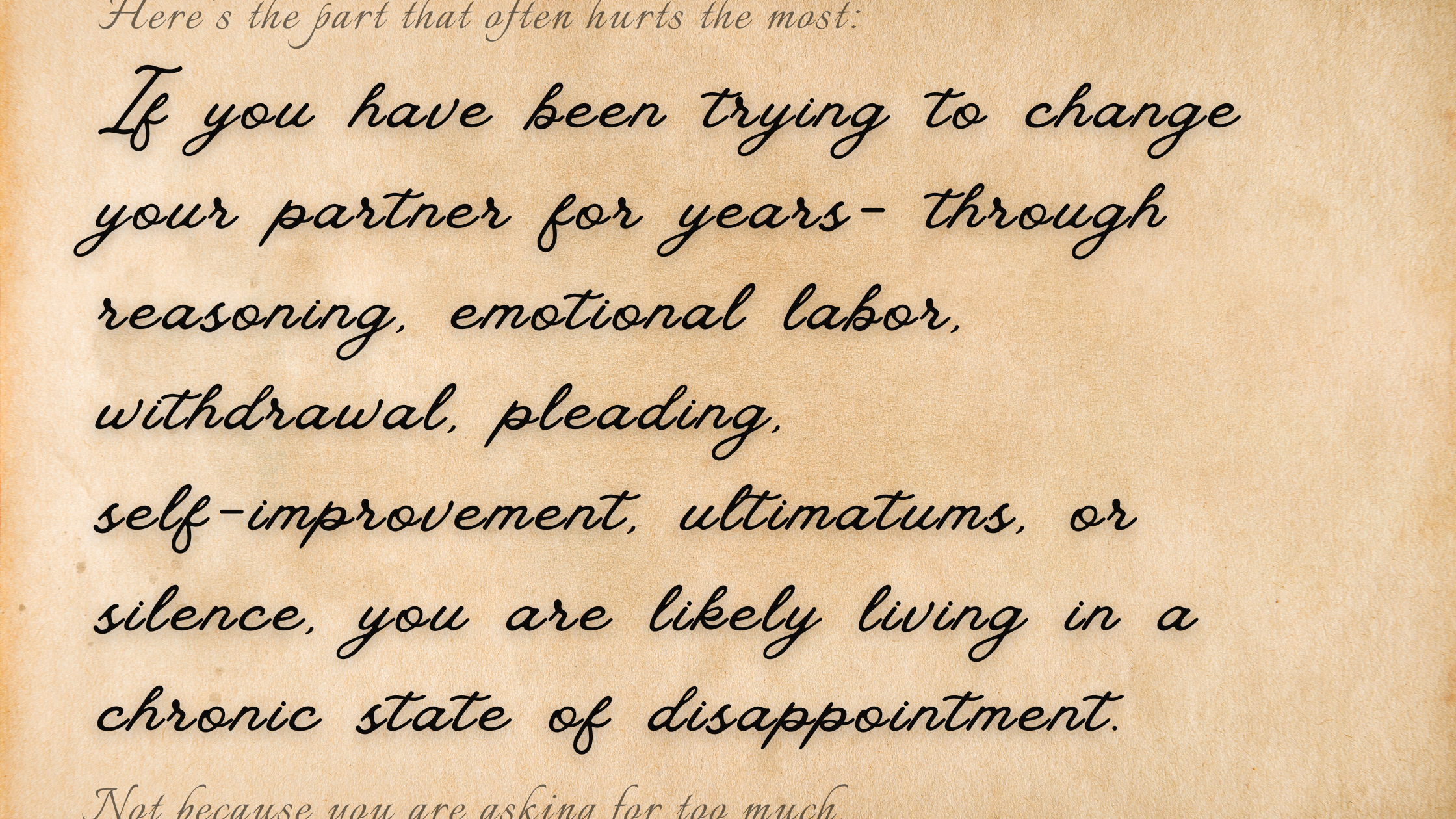
But because you are asking the wrong person to meet needs they have shown you, over time, they cannot or will not meet.
That doesn’t make them evil.
And it doesn’t make you foolish.
It makes you human.
But it does require a reckoning.
Acceptance asks a different question than “How do I fix this?”
It asks: If nothing changed from this moment forward, could I live this life without losing myself?
This question is not meant to pressure you into leaving.
It is meant to bring you back into honesty.
Because what keeps people trapped is not the relationship itself, but the constant internal bargaining. The moving goalposts. The private deals you make with yourself:
If I just hang on a little longer…
If this season passes…
If I become less sensitive…
If they finally see…
Acceptance interrupts that cycle.
When you stop trying to change someone, one of two things happens:
You grieve.
Or you become free.
Often, you do both.
You grieve the relationship you hoped for.
The version of your partner you believed in.
The future you imagined would naturally unfold.
This grief is real- even if no one died. Even if you keep choosing this. Even if others think you should be grateful.
Unacknowledged grief turns into resentment.
Acknowledged grief turns into clarity.
And clarity is kind.
From clarity, you get to ask better questions:
- What boundaries do I need so I don’t disappear?
- Where am I over-functioning to compensate for what hurts?
- What am I giving that costs me too much?
- How do I take responsibility for my own well-being without waiting for permission—or change?
This is where love becomes cleaner.
Sometimes love looks like staying, but no longer contorting yourself.
Sometimes love looks like redefining intimacy.
Sometimes love looks like choosing yourself in quiet, consistent ways.
And sometimes love looks like preparing to leave, not in panic, not in shame, but in truth.
There is no single right ending to this story.
But there is a right beginning.
Returning your power to yourself.
You are not trapped.
You are choosing.
And you can choose again- differently or the same- but this time with open eyes.
And that, Brave Soul, is where dignity lives.
You’ve got this!
Dr. Zoe
Subscribe and Heal your Relationships.
You deserve a healthy, loving relationship and it starts with You. Learn how to untangle
Complex Shame™ and co-dependency to finally have the beautiful, secure relationship with
yourself and others that you’ve always wanted.
Subscribe and as a thank you, I’ll send you the Steps to Healing from Complex
Shame™.