
Are You Becoming Your Husband’s Mother?
I might step on some toes today, but it’s in your best interest, so get ready. Are you acting like a mother or a wife to your spouse? Is your daily mantra a constant telling him to do the things-...


When you’re standing at the altar, saying your vows, the last thing that comes to mind is “What if?” What happens if one of us is diagnosed with an incurable disease? Where does that leave me? Will I have the...
November 5, 2025

I help women overcome Complex Shame™ and co-dependency so they can experience healthy love and freedom.
READ MOREWhen you’re standing at the altar, saying your vows, the last thing that comes to mind is “What if?”
What happens if one of us is diagnosed with an incurable disease? Where does that leave me? Will I have the strength to care for them until “death do us part?”
It makes you question your faith in love and your partnership. Forget the spiel about love being unconditional. Even romantic love has its limits, and it can’t compare to the devotion you feel for your kids.
There’s no how-to guide or roadmap when faced with this reality. You might think that navigating choppy waters requires a sink-or-swim mindset. It doesn’t have to be that way.
When a serious illness enters a marriage, it can test the most devoted partnerships.
It was only a matter of time for science to join the party when asking the question, which gender is more likely to leave a sick spouse? Let it be noted for posterity’s sake that a study published in the Journal of Health and Social Behavior was done on a large scale. Roughly 2,700 marriages, to be exact.
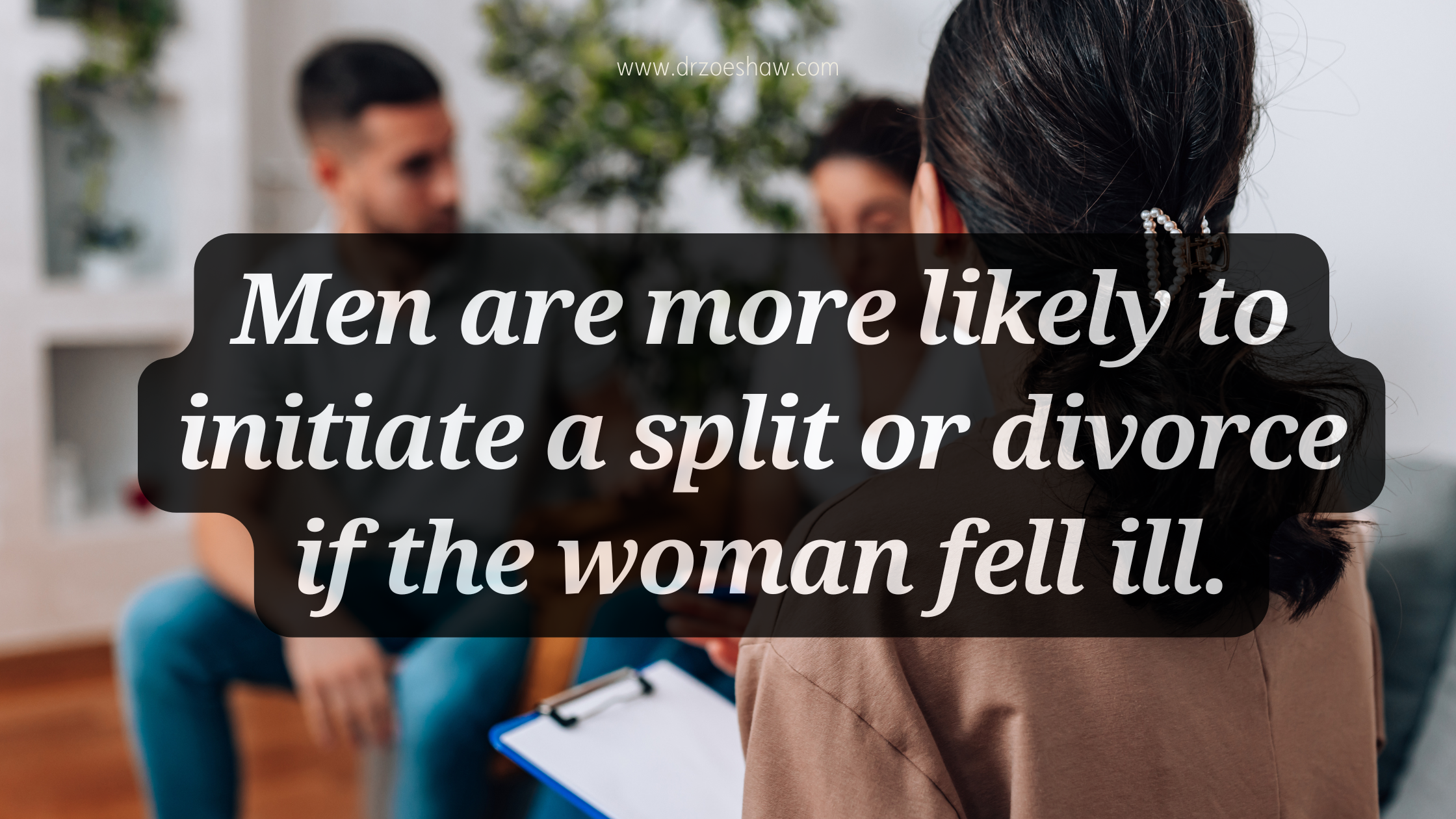
Researchers examined the effects of serious illnesses on marriages in middle-aged and older adults. The findings suggested that a wife’s illness foreshadowed an increased risk of divorce. A more recent study found that men were more likely to initiate a split or divorce if the woman fell ill.
I’m thinking women aren’t surprised by those stats. After all, her role is to be the nurturer in the home. And that’s where the problem lies.
Medical doctor Jonathan Redelinghuys tells The Citizen that the data reflects the expectations put on women by society. She is supposed to be the caregiver. And that expectancy is carried into marriage.
Men aren’t as good at taking on the responsibility of primary caregiver. They struggle with switching gears.
Yes, people recover all the time from an illness, but what happens if the very treatment that is supposed to cure you makes you sicker?
Living with sickle cell disease is a lifelong condition nobody asks for, and when in a relationship, the stakes are higher.
Sickle Cell Disease News claims that finding a partner who understands the disease can be complicated. Marrying someone with a compatible genotype also eliminates the risk of passing on the disease to your children.
When the sickle cell drug Oxbryta was approved for market in 2019, many saw it as a miracle sickle cell disease treatment. The medication was designed to improve oxygen delivery in sickle cell patients. And then the Oxbryta lawsuit emerged.
Data raised serious concerns about its safety following clinical trials, particularly among pediatric users. Victims accused Oxbryta’s manufacturer of failing to adequately warn about severe complications and the risk of brain swelling and liver injury. TorHoerman Law says that young Oxbryta users suffered life-threatening neurological events after being administered the drug.
Imagine the distress caused when a pill promises the world and then falls short of that promise? It reminds me of marriage, but both partners have a choice. Stay or leave?
Start by being honest with yourself. Do you have the mental and physical capacity to be both caretaker and partner, asks VeryWell Mind. Are you invested enough in the marriage to see things through?
These questions may seem unpleasant, but sitting in your discomfort is the only way forward.
Couples therapy can be a light in uncertain times. It helps iron out issues you weren’t aware of until now. Talking with a professional honestly and openly about the future of your relationship can be a cathartic process.
During an interview with KFF Health News, a professor of psychiatry said that couples should communicate effectively about respecting each other’s needs.
“Find out what you can do together and what each of you can do separately,” he explained. Share activities like reading books together and going to the theater. Add new experiences as well. Make it about cherished moments and not having to complete a bucket list before it’s too late.
There also has to be a sense of balance. Too often, one spouse becomes less able to do things, and the other takes on more responsibilities.
It’s easy to assign the ill spouse to the role of being “cared for.” Instead, set boundaries around caregiving to maintain mutual respect in the relationship.
Talking about mutual respect, the last thing your sick partner wants is you treating them with pity. If you can’t get past those emotions, then you’re in trouble.
You deserve a healthy, loving relationship and it starts with You. Learn how to untangle Complex Shame™ and co-dependency to finally have the beautiful, secure relationship with yourself and others that you’ve always wanted.
Subscribe and as a thank you, I’ll send you the Steps to Healing from Complex Shame™.
I might step on some toes today, but it’s in your best interest, so get ready. Are you acting like a mother or a wife to your spouse? Is your daily mantra a constant telling him to do the things-...

You come home exhausted, your partner says the wrong thing, and suddenly a small comment turns into a full-blown argument. Does that sound familiar? Chronic stress doesn't just wear you down. It chips away at your relationship in ways you...

The day you gave birth to your beautiful baby, you never imagined you would be in this situation. We all know the term- Baby Mama. No one purposefully becomes one. But it’s the reality of our modern world and it’s...
©2026 Dr. Zoe. Designed And Developed By Ogrelogic. Privacy Policy


